

It is easy to forget that not all that long ago, Britain was one of the world's biggest oil producers.
Back in 1986, this country was the fifth biggest crude producer in the world, just behind Mexico and above Iran and Iraq. Even as recently as the turn of the millennium, the UK was still in the top ten.
It is easy to forget, too, that as the oil gushed out of the North Sea it had an extraordinary impact on Britain's public finances. In the middle of the 1980s, North Sea oil revenues accounted for a whopping 6% of all government revenues - the equivalent, in today's money, of every pound we spend on our armed forces.
Yet speak to most folks, both in Westminster and beyond, these days and not only have they typically forgotten this history, they also assume something else: that the North Sea is essentially finished.
Such questions, always hotly debated, are suddenly all-important, given Britain is once again facing a sharp increase in energy prices, after the attacks on Iran and the closure of the Strait of Hormuz sent oil and gas prices spiralling.
To some extent, this whole debate can be boiled down to a chart which frequently does the rounds in Westminster. It shows a precipitous decline in North Sea oil and gas production. And, even more damningly, it shows that even if there is more exploration and further discoveries, production would barely be any higher. The Labour MP Jeevun Sandher recently reproduced a version of this chart on X, in response to calls to explore for more North Sea gas, commenting: "What North Sea gas?"
I should probably come clean and admit that I have occasionally reproduced this chart as proof that there is little left to be squeezed out of the North Sea, even if we wanted to. But then I dug a bit further and found something intriguing. In fact, the chart isn't necessarily inevitable; in fact, North Sea production could be considerably higher.
To understand why we need to start with a little bit of geology. The North Sea is what most folks in the oil sector call a "mature basin". This doesn't mean there's no oil left or indeed that new discoveries couldn't happen (Norwegian firms seem to be discovering rather a lot of new fields at the moment) but it does mean there are pretty good geological maps of most of the region.
And we have a pretty good sense of how much oil and gas there is beneath the surface of the seabed. Those figures are marshalled by an organisation called the North Sea Transition Authority (NSTA), which does for oil and gas figures what the Office for Budget Responsibility does for the government's economic and fiscal numbers - it's a sort of independent regulator within government.
And one of the important jobs the NSTA does is to tot up how much oil and gas there is thought to be beneath the sea. Those figures, reserves and resources as they're known, are relatively uncontentious. Some of the oil and gas is easy to extract, because it's in areas with uncomplicated geology and is close to existing pipelines. Other parts are far more challenging. In those parts it would take much more investment and effort to get the hydrocarbons out. And the decision to invest depends on all sorts of factors - everything from oil prices to tax levels to regulations.
But if you look at these charts - for instance the one for gas, at least three things leap out. First, there's rather a lot of gas - over three billion tonnes. The estimates of total reserves and resources have been going up over time. Second, the majority of that gas - roughly 80% depending on how you skin these things - has already been extracted. Third, of that remaining 20%, the majority falls into the hard-to-get category.
So that's the starting point: there's a decent if not overwhelming amount of oil and gas. But the more you want to get, the harder (and more expensive) it gets to extract. All of which brings us back to that "What North Sea Gas" chart posted by Jeevun Sandher. It turns out that this chart is not a concrete forecast. Instead it's determined by the prevailing economic conditions, taxes and regulations faced by North Sea oil producers.
You can see as much if you look back through its history. Back in 2023, before the current government came in and imposed its ban on new licenses and exploration in new fields, it projected that by 2050 we could be getting 2 mboe (million barrels of oil equivalent) of gas out of the North Sea. But when it came to do the same exercise in 2026, after the new government came in and imposed its new rules (and kept the post-Ukraine windfall tax in place) the projected amount coming out by 2050 was only 1 mboe.
The projected output in that year had halved. Far from being set in stone, in other words, this chart is subject to quite a lot of variations, as the various rules on North Sea exploration and production change.
All of which raises a question - a question that's being asked more and more these days: how much oil and gas could Britain extract from the North Sea if it really wanted to? If those taxes on producers were cut, could Britain become energy independent all over again?
That's a thought experiment the North Sea producers' lobby group, OEUK, has now carried out. And it has found that while UK gas production would continue to fall, in a best-case scenario, it would fall far slower than those current projections. And since UK gas consumption is expected to fall rapidly in the coming years, thanks to all those incentives to bring in heat pumps and make more of our power renewable, come 2035 UK North Sea gas could satisfy more than half of Britain's demand.
Full energy independence is still a long way away, based even on these optimistic assumptions. But, critically, this would mean the UK being considerably less dependent on imports than it is current projected to.
And that brings us back to the big story of the day. If that "What North Sea Gas" chart proves to be right, it implies Britain becoming dependent on imported Liquefied Natural Gas for almost half of its consumption in a decade or so. That means being dependent on countries like the US and Qatar, it means potentially paying more for gas (since LNG is quite expensive to refrigerate and condense) and it means emitting more carbon (since the process of making and shipping LNG involves quite a lot of carbon emissions).
All of which is to say, the case for reconsidering the economic environment in the North Sea is very different today than it was only a few years ago. And if that environment were to change, there could plausibly be significantly more oil and gas coming out of this basin. While still declining, the fall would be far less precipitous than is currently assumed.

(c) Sky News 2026: North Sea oil - is it time to reconsider drilling?
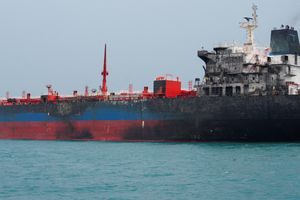 Naval escorts could make tankers a target for Iran, warns UN maritime chief
 Mark Kleinman blog | See the latest stories from Sky News' City editor
 Government prepares to sue Roman Abramovich after he missed deadline to release £2.5bn from Chelsea sale